



Fiedler O Mastrangelo
Our practice begins in language before it becomes image.
Giulia writes visual poetry built from contradiction placed against contradiction, words positioned one after another so the tension sits in the gap between them, not inside either word alone.
The canvas is then divided into as many fields as the poem has strophes. As she reads aloud, each section receives Nicolas' painterly response: A translation of what hearing it does to him in that moment.
What passes into the painting from there is a state. Pages torn from the books she's been using as a research base are inscribed in ink across their blank areas and placed against the surface, bringing the source back in as material. Selected paintings migrate again, reinterpreted by hand into sculptural form. A viewer may connect with what was in the room when the strophe was read, or may not. That isn't guaranteed, and we don't build it to be.
We arrived from opposite directions, one from the Brazilian Atlantic forest and the other from Milan, one trained in architecture and geometry, the other in the slippage of language. Neither of us is a single origin to begin with.
The question we hoped to answer was how cooperation would affect us individually. This is why the work keeps returning to human nature. Every contradiction we place on a canvas was first a real one between us, or inside one of us.
Artists
Giulia Mastrangelo was trained between Milan (NABA) and Venice (Ca' Foscari University). Her practice is built on the instability of language, on the moment where a single word, a concept, placed within a chain of others, shifts. Where language stops describing and starts generating.
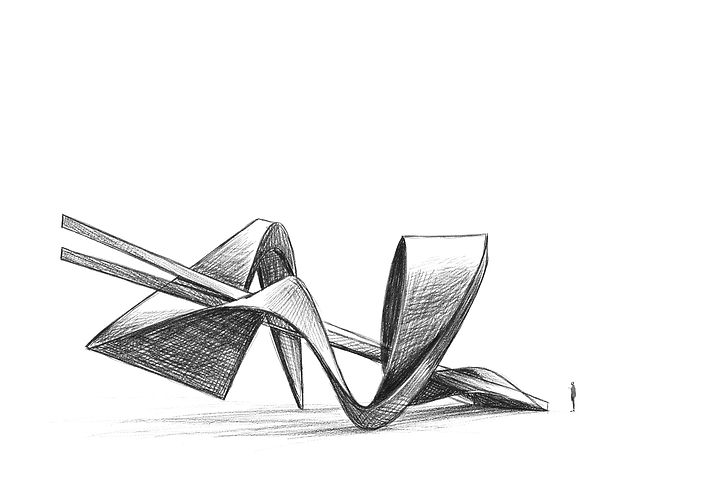
Nicolas Fiedler grew up in contact with the Brazilian Atlantic jungle, where his first experiments in drawing began, and later studied Architecture(Fau). His practice moves between organic structure and constructed geometry, pursuing the mathematical logic underlying natural form.
Solo Exhibitions
2026 — non-Solo, Spazio Thetis, Arsenale, Venice
2024 — Contrappunto, Crea Cantieri del Contemporaneo, Venice
Group Exhibitions
2026 — The Visionauts(I Visionauti), Galleria Berrino, Alassio
2026 — Restless Sweetness(Dolcezza Inquieta), Galleria Berrino, Alassio
2026 — Alassio Città degli Artisti, Galleria Berrino, Alassio
2026 — Places to Live, Giorgetti Spiga, Milan
2026 — La Notte, Fabbrica del Vapore, Milan
2026 — Art Fiera Bologna, Bologna
2026 — [Untitled Site-Specific Installation], Giorgetti Spiga, Milan
2025 — Artefici del Nostro Tempo, Venice Architecture Biennale, Pavilion 29, Venice
2025 — Aizenev Exhibition, Venice
2025 — RoCollectible, Galleria Rossana Orlandi, Milan
2024/2025 — Murano Illumina il Mondo, Procuratie Vecchie, Piazza San Marco, Venice
2024 — Premio Arte, Museo della Permanente, Milan
2023 — Better World, Chiesa della Misericordia, Venice
2023 — Venice Impact Awards, Human Safety Net Foundation, Venice
2022 — Cavalcare le Soglie, Basilica di San Lorenzo in Lucina, Rome
2022 — French Cultural Institute, Larissa
2021 — Venice Architecture Biennale, Palazzo Mora, Venice
2021 — Otto Zoo Gallery, Milan
Awards
2025 — Artefici del Nostro Tempo Prize for artists under 35, Pavilion 29, Venice Architecture Biennale
2024 — Best Sculpture, Premio Arte, presented by Arte magazine
Residencies
2026 — Città degli Artisti, Alassio
2026 — ViaFarini, Milan
2026 — Serrinha Institute, São Paulo
Publications
2025 — Murano Illumina il Mondo Catalog
2025 — Artefici del Nostro Tempo Catalog
2025 — RoCollectible 2025, Rossana Orlandi Catalog
2024 — 59° Catalogo dell'Arte Moderna
Exhibitions and residencies listed for past years have already taken place. Those listed for the current or future years are scheduled and subject to change.

© 2026 by Fiedler O Mastrangelo duo.
Fiedler O Mastrangelo duo


Dorsoduro, 30123, Venice, Italy. | Via Marco D'Agrate, 33, Milano, Italy | Guaruja, 11420130, São Paulo, Brazil.